Embora relacionada a Ligeti, temos outros exemplos como em cantos tradicionais, como o Regilaul.
Regilaul
https://www.youtube.com/watch?v=aApY_s2YFt4
https://www.youtube.com/watch?v=lebVYcfBBzM
https://www.quora.com/Have-composers-other-than-Ligeti-used-micropolyphony
Além disso,
Paul Dessau - Musik für 15 Streichinstrumente
Erkki-Sven Tüür - Insula Deserta for string orchestra (1989)
Regilaul
https://www.youtube.com/watch?v=aApY_s2YFt4
https://www.youtube.com/watch?v=lebVYcfBBzM
https://www.quora.com/Have-composers-other-than-Ligeti-used-micropolyphony
Além disso,
Paul Dessau - Musik für 15 Streichinstrumente
https://www.youtube.com/watch?v=9Lq-ZAqnKk0
https://www.youtube.com/watch?v=ZAjFSlMMDNE
Salmenhaara, Erikki
https://www.youtube.com/watch?v=7EfSueYuUNk
Eu já vinha desde o ano passado, desde a primeira orquestração (para Composição IV), tentando inserir técnicas de contraponto denso ou micropolifonia. Mas eu me chocava com a correlação entre os materiais ( as pinturas) e suas possiblidades musicais. Ou seja, a organização do quadro dialogava com determinada concepção de estruturação musical. Embora tenha estudado micropolifonia desde o ano passado, não a apliquei totalmente em virtude das pinturas mesmas.
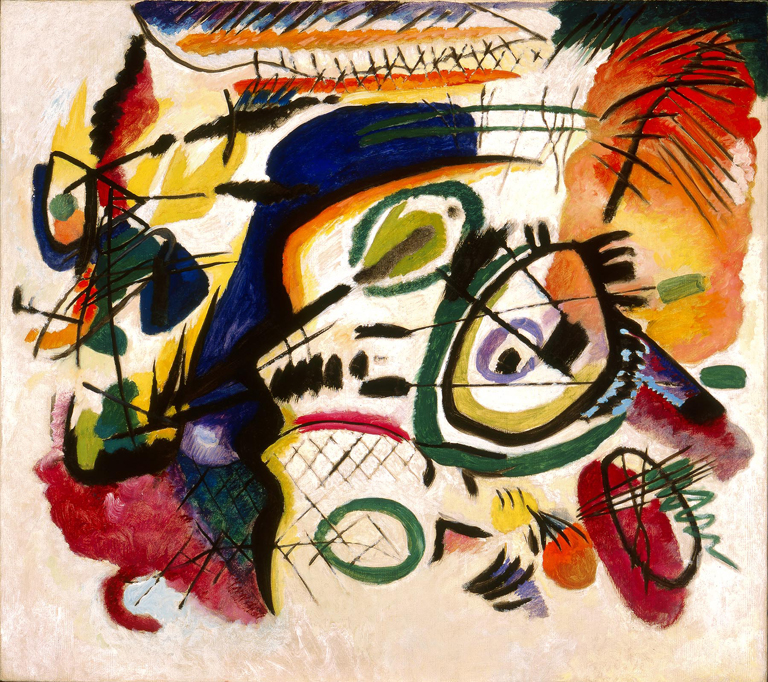
Mas o caminho da Composição I para a Composição VII é o de uma maior consciência dessa correlação entre a forma de organização dos materiais pictóricos e a música. No texto que escreve para Composição VI, Kandinsky refere-se claramente a "fuga". Em alguns momentos da orquestração para a Composição VI eu me me vali de técnicas contrapontísticas. Mas meu medo nesse tempo foi o de não impor uma estruturação musical que se descolasse da pintura, ou que essa forma não seguisse um caminho em si, autoevidente.
Agora, retorno à questão com o trabalho com essa Composição VII.
Uma pista que me agradou muito é que a polifonia sempre é vista em função da composição musical erudita. Mas outros itinerários. Por exemplo, entre os povos fino-úgricos, que providenciou o background para o Kalevala, temos um cancioneiro (Regilaul, Canções das Runas, regilaulud) que se manifesta, entre outras maneiras, no jogo de alternâncias entre um cantor e um coro- o coro retomando o material apresentado pelo cantor. O jogo é expresso por meio de ritmos constantes (versos de oito sílabas).
V. Jaan Ross, Ilse Lehiste,The Temporal Structure of Estonian Runic Songs
Em sua última obra, Lauliku lõpusõnad ( As palavras finais do Cantor), Veljo Tormis compõe, a partir dos últimos versos do Kalevala, uma canção valendo-se desse metro, o metro do Kalevala. Link: https://www.youtube.com/watch?v=tRzJa4A2bA0 .
V. Mimi S. Daitz, Ancient Song Recovered: The Life and Music of Veljo Tormis, Volume 1.
- Database desse cancioneiro: http://www.folklore.ee/regilaul/introduction
- Documentário: https://www.cultureunplugged.com/documentary/watch-online/play/11667/Regilaul---Songs-of-the-Ancient-Sea
- Links/: https://www.folklore.ee/folklore/vol7/maripar.htm
- SObre Ligeti
https://upload.wikimedia.org/wikipedia/commons/9/92/Ligeti-Micropolyphony.pdf
V. Ligeti Atmospheres
https://www.youtube.com/watch?v=JWlwCRlVh7M
https://www.universaledition.com/listeninglab2-en
http://theidiomaticorchestra.net/part-1-2/
https://josephklein.music.unt.edu/sites/default/files/80-90_timbre_texture_space_02-29-12.pdf
Artigos
1- Claudio Vitale, Bewegungsfarbe e cânone sobressaturado: Atmosphères de György Ligeti. Link: http://vortex.unespar.edu.br/vitale_v4_n2.pdf
2- Allan Souza. Confluências histórico-técnicas no conceito de micropolifonia (1956-1966). Link: https://repositorio.unesp.br/handle/11449/110651
3- Stephen Satory, An Interview with György Ligeti in Hamburg Stephen Satory. Link: https://www.erudit.org/fr/revues/cumr/1990-v10-n1-cumr0505/1014897ar.pdf .
4- Bernard, Jonathan W. (1994). "Voice Leading as a Spatial Function in the Music of Ligeti". Music Analysis 13, nos. 2/3 (July–October): 227–53.
Livro:- Tatiana Catanzaro,Transformações na Linguagem Musical Contemporânea Instrumental e Vocal.
- Richard Steinitz.Gyorgy Ligeti. Music of the Imagination.
Textos de Ligeti
"PENSÉES RHAPSODIQUES SUR LA MUSIQUE EN GÉNÉRAL ET SUR MES PROPRES COMPOSITIONS EN PARTICULIER"
"MUSIQUE ET TECHNIQUE Expériences personnelles et considérations subjectives"
Aracnofobia de Ligeti

Link: https://www.auroraorchestra.com/2018/05/04/ligetis-imaginative-world/
Eu já vinha desde o ano passado, desde a primeira orquestração (para Composição IV), tentando inserir técnicas de contraponto denso ou micropolifonia. Mas eu me chocava com a correlação entre os materiais ( as pinturas) e suas possiblidades musicais. Ou seja, a organização do quadro dialogava com determinada concepção de estruturação musical. Embora tenha estudado micropolifonia desde o ano passado, não a apliquei totalmente em virtude das pinturas mesmas.
Mas o caminho da Composição I para a Composição VII é o de uma maior consciência dessa correlação entre a forma de organização dos materiais pictóricos e a música. No texto que escreve para Composição VI, Kandinsky refere-se claramente a "fuga". Em alguns momentos da orquestração para a Composição VI eu me me vali de técnicas contrapontísticas. Mas meu medo nesse tempo foi o de não impor uma estruturação musical que se descolasse da pintura, ou que essa forma não seguisse um caminho em si, autoevidente.
Agora, retorno à questão com o trabalho com essa Composição VII.
Uma pista que me agradou muito é que a polifonia sempre é vista em função da composição musical erudita. Mas outros itinerários. Por exemplo, entre os povos fino-úgricos, que providenciou o background para o Kalevala, temos um cancioneiro (Regilaul, Canções das Runas, regilaulud) que se manifesta, entre outras maneiras, no jogo de alternâncias entre um cantor e um coro- o coro retomando o material apresentado pelo cantor. O jogo é expresso por meio de ritmos constantes (versos de oito sílabas).
V. Jaan Ross, Ilse Lehiste,The Temporal Structure of Estonian Runic Songs
Em sua última obra, Lauliku lõpusõnad ( As palavras finais do Cantor), Veljo Tormis compõe, a partir dos últimos versos do Kalevala, uma canção valendo-se desse metro, o metro do Kalevala. Link: https://www.youtube.com/watch?v=tRzJa4A2bA0 .
V. Mimi S. Daitz, Ancient Song Recovered: The Life and Music of Veljo Tormis, Volume 1.
- Database desse cancioneiro: http://www.folklore.ee/regilaul/introduction
- Documentário: https://www.cultureunplugged.com/documentary/watch-online/play/11667/Regilaul---Songs-of-the-Ancient-Sea
- Links/: https://www.folklore.ee/folklore/vol7/maripar.htm
- SObre Ligeti
https://upload.wikimedia.org/wikipedia/commons/9/92/Ligeti-Micropolyphony.pdf
V. Ligeti Atmospheres
https://www.youtube.com/watch?v=JWlwCRlVh7M
https://www.universaledition.com/listeninglab2-en
http://theidiomaticorchestra.net/part-1-2/
https://josephklein.music.unt.edu/sites/default/files/80-90_timbre_texture_space_02-29-12.pdf
Artigos
1- Claudio Vitale, Bewegungsfarbe e cânone sobressaturado: Atmosphères de György Ligeti. Link: http://vortex.unespar.edu.br/vitale_v4_n2.pdf
2- Allan Souza. Confluências histórico-técnicas no conceito de micropolifonia (1956-1966). Link: https://repositorio.unesp.br/handle/11449/110651
3- Stephen Satory, An Interview with György Ligeti in Hamburg Stephen Satory. Link: https://www.erudit.org/fr/revues/cumr/1990-v10-n1-cumr0505/1014897ar.pdf .
4- Bernard, Jonathan W. (1994). "Voice Leading as a Spatial Function in the Music of Ligeti". Music Analysis 13, nos. 2/3 (July–October): 227–53.
Livro:- Tatiana Catanzaro,Transformações na Linguagem Musical Contemporânea Instrumental e Vocal.
- Richard Steinitz.Gyorgy Ligeti. Music of the Imagination.
Textos de Ligeti
"PENSÉES RHAPSODIQUES SUR LA MUSIQUE EN GÉNÉRAL ET SUR MES PROPRES COMPOSITIONS EN PARTICULIER"
"MUSIQUE ET TECHNIQUE Expériences personnelles et considérations subjectives"
Aracnofobia de Ligeti

Link: https://www.auroraorchestra.com/2018/05/04/ligetis-imaginative-world/